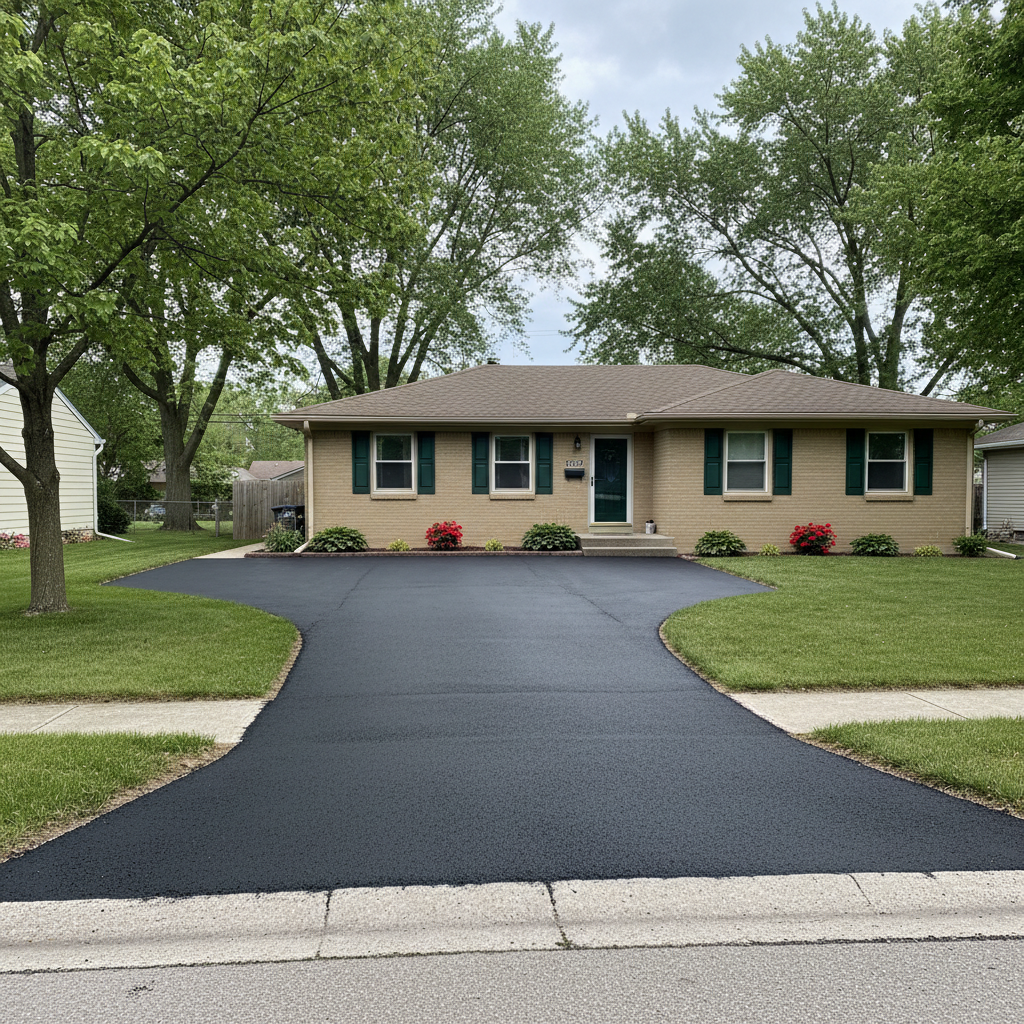
Alright, let's talk about slurry sealing your asphalt. It's a great way to protect your pavement, extend its life, and make it look sharp again. But naturally, the first thing folks want to know is, "What's this going to cost me?" It's a fair question, and I'm going to lay it all out for you, specifically for us here in Michigan City.
What Even IS Slurry Sealing?
Before we dive into dollars and cents, let's quickly clear up what slurry sealing is. It's not just a fancy name for sealcoating. Slurry seal is a mixture of asphalt emulsion, aggregates (small crushed stone), water, and some additives. It's applied in a thin, uniform layer over existing asphalt. Think of it as a tougher, thicker, and more durable protective layer than a standard sealcoat. It fills minor cracks, improves skid resistance, and gives your pavement a fresh, black appearance. It's particularly good for surfaces that have seen a few Michigan winters and need more than just a cosmetic touch-up.
What Drives the Price Tag?
You know how it is with any home or business improvement project – a lot of factors play into the final cost. Slurry sealing is no different. Here's what I look at when I'm putting together a quote:
- Size of the Area: This is the biggest one, plain and simple. The more square footage, the more material and labor needed. We usually price by the square foot.
- Current Condition of Your Pavement: If your asphalt has a bunch of big cracks, potholes, or significant damage, we'll need to do some repair work first. Slurry seal isn't a miracle cure for severely deteriorated pavement. Patching, crack filling, and other prep work will add to the cost.
- Accessibility: Is your driveway easy to get to? Is it a tight parking lot with a lot of obstacles or tricky turns? If we have to spend extra time maneuvering equipment or doing more hand work, that can affect labor costs.
- Number of Coats: Most residential jobs will get one good coat. Larger commercial projects, especially those with heavy traffic, might benefit from two coats for extra durability, which obviously doubles the material cost.
- Traffic Control & Striping: For commercial parking lots, we often need to factor in traffic control during the application and then re-striping parking spaces and directional arrows afterward.
- Material Quality: Not all slurry mixes are created equal. At Oasis Asphalt Solutions, we use high-quality materials designed to stand up to our Michigan City weather, from the lake-effect snow to the hot, humid summers.
Typical Cost Ranges in Michigan City
Alright, let's get to some numbers. Keep in mind these are averages, and your specific project might fall outside these ranges depending on the factors I just mentioned.
- Residential Driveways: For a typical residential driveway (say, 500-1,000 sq ft) in decent shape, you're usually looking at anywhere from $0.80 to $1.50 per square foot. So, a 750 sq ft driveway might run you $600 to $1,125. If there's a fair bit of crack filling needed, it could push it towards the higher end.
- Small Commercial Lots: For smaller commercial properties or larger residential driveways (1,000-5,000 sq ft), the price per square foot often drops a bit due to economies of scale, usually in the range of $0.70 to $1.20 per square foot. This means a 3,000 sq ft lot could be $2,100 to $3,600.
- Large Commercial Projects: For big parking lots (5,000+ sq ft), the price can go down further, sometimes as low as $0.60 to $1.00 per square foot, especially if the surface is relatively clean and doesn't require extensive repairs.
Remember, these numbers typically include the basic cleaning and application of one coat of slurry seal. Any significant repair work, extensive crack filling, or re-striping will be added on.
What Should Be in Your Quote?
When you get a quote, don't just look at the bottom line. Make sure it's detailed. A good quote should clearly state:
- The total square footage being treated.
- The type of material being used (e.g., "Type II Slurry Seal").
- The number of coats.
- Any included prep work (e.g., "blow debris, sweep, minor crack filling up to 1/4 inch").
- Any additional services and their costs (e.g., "major crack filling," "pothole repair," "striping").
- A timeline for the work.
- Warranty information.
How to Avoid Overpaying (and Under-Doing It)
Here's my advice:
- Get Multiple Quotes: Always get at least three quotes. It helps you compare not just prices, but also what's included and the contractor's professionalism.
- Ask for References: A reputable contractor will be happy to provide them.
- Understand the Prep Work: Don't skimp on prep. If a quote is significantly lower than others, it might be because they're cutting corners on cleaning or crack repair, and that'll cost you more in the long run. Slurry seal needs a clean, stable surface to adhere properly.
- Check Insurance and Licensing: Make sure any contractor you hire is properly insured and licensed. You don't want liability falling on you if something goes wrong.
- Don't Go for the Cheapest Bid Automatically: The lowest price isn't always the best value. Sometimes, paying a little more upfront for quality materials and experienced workmanship saves you a lot of headaches and money down the road.
Slurry sealing is a smart investment for your asphalt. It's a cost-effective way to maintain your property and keep it looking great. Just make sure you know what you're paying for and who you're hiring. If you're in Michigan City or the surrounding areas and have questions, give us a call at Oasis Asphalt Solutions. We're always happy to talk pavement.